Summmon Through Fire


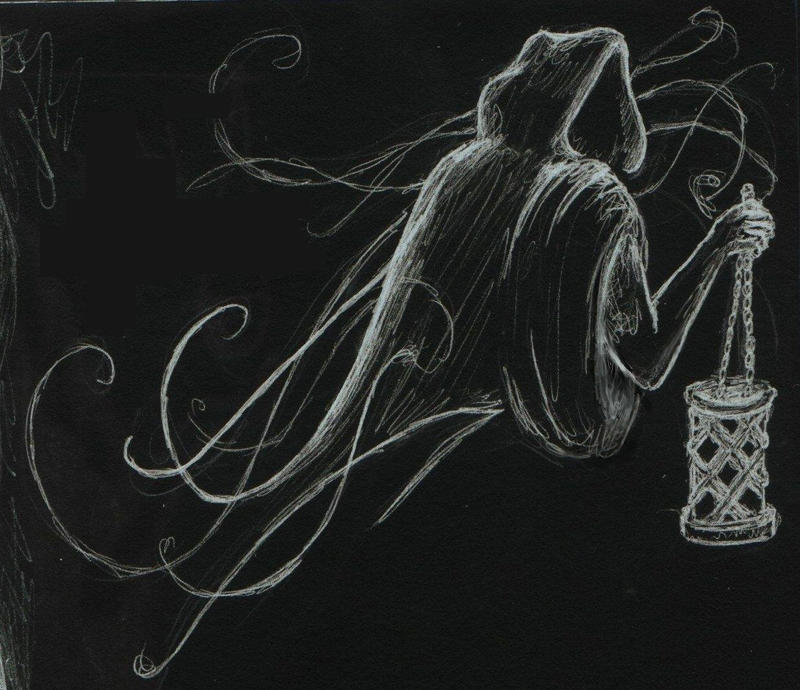
An alchemical drawing by
Theodoros Pelecanos, dated 1478,
which inspired the design of the book.
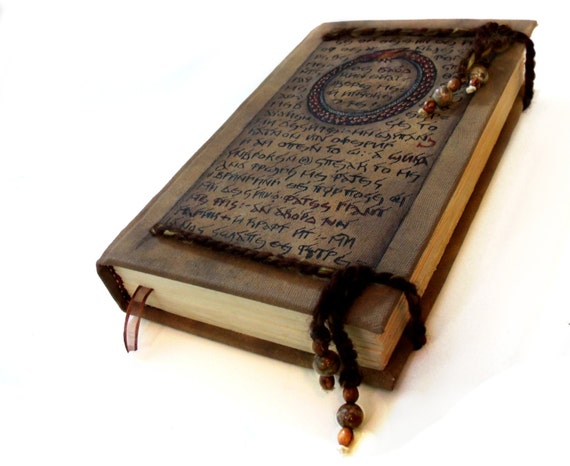
 The purpose of my words below is a kind of opening. A call to power. Rather than summoning the watchtowers or invoking the elements, this can be used. When you're not prone to wordy and ritualistic castings it can be very helpful to have simple words before you get to what you're actually there to do.

It calls to blood ancestors, to lifting the veil and stretching the sight. This is said as the candles are lit, as you hone your mind to task. The final line, "my hands shape the future," prepares your mind and magic to do what comes next. Whether that's an protection spell from the Romanus Buchlein, a drawing down the goddess charge, a mental work aided by flame, or merely closing your eyes and sending your will out. This is a good place to start. 

The Ouroboros is a sigil of integration of ones self and opposite nature. Devouring and consuming force which swallows you and feeds you at once. Death, and then new life, endlessly. It is also used in alchemical illustrations, where it symbolizes the circular nature of the alchemist's Great Work. The endless quest, the wide circle around one self. In this instance I particularly like it because of the blood, ancestral connections referenced in the spell. A sense that we always remain connected, and nothing is lost. What dies goes to earth, what is lost we grow strong from the absence of. We are always turning, changing, always new and always in circles around ourselves.

The Spell  This is was written by me, anyone is free to
put it in their BOS or use it personally, but do not publish it.


Translation of my script;
Summon through fire
See through smoke
In the eyes of the ancestors before me,
the blood-kin which bore me,
spirits which gave me breath.
Flame bear witness to my desire
my supplication in offering
I am open to you
a circle unbroken
speak to me, and through me
bringing the will of my design
Fates grant me this,
an accord, in magic
I craft it

my hands shape the future.


More About This Book
Please note that the text in the first image, by Theodorus, is NOT the same as the text used in my spell/book. I borrowed from the basic design of the serpent and the kind of alphabet used, nothing more. Do not mistake my spell as a translation of Theordorus's ouroboros page.
Coptic Alphabet Key - Link
Ann Enchanted book shop - Link
This book is also on deviant art - Link


Wildwood Tarot

The Companion Book.
 Where splashed the murmur of the forest's fountains;

With all her loveliness did she beseech,

And all the sorrow of her wildwood charms.

 Madison J Cawein

Wild Wood Tarot Review
 Wildwood Tarot by Mark Ryan & John Mathews
Illustrated by Will Worthington 
Review by Angie, Ann Enchanted
 
I am a fiercely hesitant shopper, and will have a lot of questions about a tarot deck before I buy one. Often the information I seek is nowhere to be found. Here I will try to answer what I would have liked to have known, and dive into the pros and cons of the deck, as well as how it handles in actual use. As a side note, please be aware that images used here are from my own copy of the deck where I have trimmed the borders off.
  

The cards are rather lovely to look at, first of all. The artist has a wonderful command of water scenes, and uses it often in his art here. Perhaps my favorite visual aspect of the cards is how the scenes have a sense of stepping inside, or continuing. There's a real feeling of depth and attention to background detail that invite the viewer to lean in, focus, think. Personally, I much prefer this style to decks that rely on a central foreground figure and give a basic wash of color to the background. 
Another very important visual aspect of the deck is that there are no awkwardly floating suit symbols, yet each of the minor arcana can easily be tied to it's correct suit and number. The ten of stones is featured at right, this would be pentacles/coins in another deck, and here we find no floating disks or clever placed pentacles. Instead we find the ten heavy stones of an ancient archway. As the pentacles, or stones in this case, are tied to the element of earth the Wildwood at last offers a deck where the suit of pentacles gives a real sense of solidity and structure. In a nature based religion, as most in their brand of craft tend to be, this alone gives the deck an invaluable and beautifully grounded feel that makes it an excellent meditative and divination tool.

Click to expand image
 Animal Cards
Perhaps the first daunting feature of this deck is the heavy use of animals. All of the court cards are animals, with many other animals scattered throughout the deck. Many of the Major Arcana have animals as central figures, or show a figure that is part animal (such as the Heirophant / "Ancestor", pictured at center left).
I had my doubts about an animal ensemble cast of court cards, but this is one of the many instances where the companion book really shines. The explanations of the court cards, the behavior of that animal and how that can be translated to events or people, is a system that works wonders in spreads. The use of animals quickly became a major strength of the deck and now I'm quite fond of it.

Cards Themselves
Measure 3” x 4 ¾” and I was pleasantly surprised by the cardstock. This deck was not printed on the thin flexible cardstock often found in new decks, but is a thicker sort. The back of the cards (with that gorgeous tree of life, pictured below) have a textured surface which gives off a lovely kind of grip. The card's face has a smooth lamination, and shuffles well.

The Book
The book is thick enough, 154 pages, and offers some original spreads. The Wildwood makes a lot of bold decisions, use of themes and renaming of cards, and therefore most people coming to the deck will need to rely on the book to get them going. For that reason I very much appreciate the layout of the book, which is arranged in a logical way that makes it very easy to quickly land on the page you need while doing a reading.

Wildwood Renaming
The standard tarot suit system are pentacles, wands, cups, and swords. The Wildwood has Arrows (Swords), Bows (Wands), Stones (Pentacles) and Vessels (Cups).
Additionally, all of the major arcana have been renamed, as follows. 0 The Wanderer (The Fool) 1 The Shaman (The Magician)  2 The Seer (The High Priestess)  3 The Green Woman (The Empress)  4 The Green Man (Emperor)  5 The Ancestor (The Hierophant)  6 The Forest Lovers (The Lovers)  7 The Archer (The Chariot)  8 The Stag (Strength)  9 The Hooded Man (The Hermit) 10 The Wheel (The Wheel of Fortune)  11 The Woodward (Justice) 12 The Mirror (Hanged Man) 13 The Journey (Death) 14 Balance (Temperance) 15 The Guardian (The Devil) 16 The Blasted Oak (The Tower and The Hanged Man) 17 The Pole Star (The Star) 18 The Moon On Water (The Moon) 19 The Sun of Life (The Sun) 20 The Great Bear (Judgment) 21 The World Tree (The World)

The renaming of the Major Arcana is hardly noticeable, except in the case of cards like the Hanged Man/Mirror where the meaning of the card has also changed. The effect of the suit changes is more noticable. First of all, as there are no swords to be found anywhere in this deck (don't know you miss it til it's gone). Then there's the bit of confusion when decks have both a bow and an arrow and the suits become mixed.

Card Meanings Changed
The cards most drastically changed in meaning I've pictured at left. Though they're quite gorgeous, these six cards specifically make up the worst thing about the deck for me. 

The Mirror replaces the hanged man, and the book offers an explanation as to why, saying, "as the hanged man sees life from another angle, so those who look into the mirror see things reflected as they truly are." Alright.. well what about the atonement, the suspension, the sacrifice? The book says, "we have chosen to amalgamate aspects of this into the Blasted Oak." (That would be their version of the Tower, a card to do with destruction and little to do with atonement.)

Possibly the worst offender of the bunch is the five of vessels/cups. This card traditionally signifies loss and disappointment, and in the Wildwood the card is named "Ecstasy." Those sound rather like opposite interpretations to me, and this time the book gives no explanation as to why the card is so significantly different. Moving up to the seven of vessels/cups we traditionally meet the dreams and imagination card which, in the Wildwood, is the card of "Mourning." The nine of arrows/swords should mean nightmares, instead it is "Dedication" etc etc. I'm perfectly fine with wrapping my mind around most themed decks, but when cards are changed from what is considered the standard without explanation, it tends to bug me. I can't stress enough that this only happens with a few cards, and does not overall hurt the deck once the initial confusion is processed and pushed aside. 

Wildwood vs Druidcraft Tarot
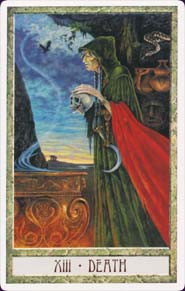
Click to view the DruidCraft
on AeclecticTarot.
It is natural to compare the two as they have similar themes and are the product of the same artist (Will Worthington). I've read reviews of the deck where the Wildwood was considered less detailed, overall inferior in artwork, to the DruidCraft. Let me dispel that right idea now.

For me, essentially the Druidcraft is colored pencils and Wildwood is watercolors. The DruidCraft (at left) uses an art style without hard lined edges, everything is shaded out in an attempt to create a smooth portrait-like feeling. The Wildwood (right) uses an entirely other style, where the black outlining is intentionally present in the art, and the color comes in to support the lines.

Also in the DruidCraft you find a lot of dense, saturated colors. Deep blue skies and rich red cloaks abound, with trees of emerald green surrounding. The Wildwood, on the other hand, uses saturated colors more sparsely. Opting instead for muted mossy greens, clouds of wisping gray, moonlit water, etc. The Wildwood is not inferior to the Druidcraft in quality or attention to detail, merely takes another approach at styling and, in my opinion, produces something overall more relaxed and contemplative.

Seal of Samhain


The sources for this working draw from greco-roman mythology and classical occultist grimoires. In both the use of planetary seals is employed. “Planet” is a latin word which originally meant “wanderers”. This was due to the fact that the classical planets were seen traveling a line through space, the ecliptic, passing each other at intervals of time that science had yet to explain. With this understanding of the word, the classical planets were Moon, Mercury, Venus, Sun, Mars, Jupiter, Saturn (in order in fastest perceptible orbit on the ecliptic line). Each with its own god persona and lore. Later, occultists took this combination of astronomy, and mythology and constructed sigils and seals to draw from the idea of that power.

I focused on Mercury and the Moon to tie in to the through-the-veil meanings of Samhain, or Halloween. Traditionally the moon is tied to water and intuitions. As a goddess she was fierce, a huntress, protective, beautiful. Mercury was a guardian of the crossroads, a farrier of souls to the underworld, a master of commerce. In the greek version of Mercury, Hermes, he was also a messenger more swift than any other. Knowledge was his trade.
The Seal Is based on the fourth pentacle of Mercury, from the Clavicula Solominis grimoire, from the book containing the order of the planetary pentacles. This incites wisdom and hidden knowledge to come forth. This seal, in its original form, aids in acquiring understanding and seeks to penetrate what it is hidden. The versicle (symbols around the seal) is in two parts. Starting at mid-left and going clockwise is a slight alteration of an elongated sigil to the Mercury. Starting and mid-right and continuing down clockwise is a sigil to the Moon.

The Spell Here is an original spell about walking between worlds, the crossroads, and invitation to true sight. It is calligraphed in an antiquated gothic script. The translation is as follows;

On this night, thin is the veil,
at Darkest hour I see most clear.
Warmth of the candle light on my face,
cold of the night against my back.
I roam with the spirits of this land.
Both worlds I seek, and see as one.
What I will I now become.

By these seals, here writ,
grant me hidden knowledge.
May I freely walk the unseen paths,
and open the far gates of wisdom.

Guardian of the crossroads;
Guide my fleet flight.
See my journey well on its way.
Throw open the doors,
and grant me vision true.

As it is written, so shall it be.

Angela B. 10-31-13 

More About This Book
Alphabet Key - Link
This book in our shop - Link
This book on deviant art - Link
  

Grimoire Empowerment Spell

Note the flap that's tucking under the cover?
That can also rest on top. See below.

A little about this book
The lettering used on this book is an antiquated gothic script. I chose a double ringed circle seal because the old grimoires always use two. One to invoke (summon, call) through, and an outer ring to differentiate one space's purpose from another. As in, within the circle the caster has dictated a different set of rules than the ordinary world. I think of journals that way. A little written world that the owner creates to get away for a little while, or see things from a different perspective, from somewhere inside the writer's own mind.


Translation of The Circle Seal 
The lettering going around the circle reads  
(Starting at the top most point, going clockwise)
Here I invoke the earth, wind, and sea.
Into my Mind, Body, and Soul.


The lettering around the triangle reads
(Starting at the top most point, going clockwise)
The Body, The Earth
The Soul, The Water
The mind, The Air


About the Symbols:
Around the triangle are the alchemical symbols for earth, water, and air. The centre triangle is also the symbol for fire, which the front panel associated with the inner will. Often the Will is thought of as the Magic-users greatest tool and greatest goal. To know it truly, and to wield it masterfully. The corners of the book have triquetra symbols, which have many meanings. They traditionally refer to faith, and the balance and unification of anything threefold. In this instance, the elements inherent in nature.

The Spell
Here I invoke all nature to lend me strength. Here I call the earth, wind,and sea - into my mind, body, and soul. My will burns as a bright flame in my heart. I am guided by light and protected by shadows and secret.
I bind this book in these powers. May all that I write within be hallowed and ever hidden. As I wish, as it is written, so be it done. Bound here to my desire.   

More about this book
Alphabet key -  Link
Work In Progress Shots on Facebook - Link
This Book in our Shop - Link
This Book on DeviantArt - Link

Without Form

Tips while Out of Body - Increase the Reality of Other Worlds
~ Leave what concerns your body behind. Try to insulate yourself from things your body may nag you about. Noise, hunger pains, uncomfortable posture. If the body has nothing to complain about while you're gone, then it will be all the easier to abandon the physical. Journeying is not the same thing as seeing some place in your mind. To fully experience astral the body has to be completely forgotten. The mind must be quieted and a deeper part of yourself let fly.

Some people are hindered by fear that fully leaving the body will be dangerous. What if you get lost? What if something steps in while you're not there?

~ Create an environment that works. There is little to no danger in astral unless you're deliberately seeking out power and high-level experiences. If you are, then you probably already know what precautions suit you. If you fear, then protect yourself. If your craft involves ritual, cast a protective circle for yourself before you go, guarded by your elements perhaps. If you like spells then cast a charm over the area that your in that allows no entry of harmful entities. If you rely on spirit work then ask friendly beings to watch over you. It all depends on your preferred flavor.

~ Notice the way you leave and come back, and standardize your steps. Pay attention to any patterns you may already have: having a particular position you sit in, item you hold, incense you burn, or visualization as you step from you body- take note of everything you do and repeat those things. This creates a trigger that will make leaving your body automatic once that stimuli is provided. Don't have a common method? Make one up! Experiment.

I read about a shaman who supposedly used two stones to induce trance state - a large rough stone and a smaller one. The small stone was dragged in a slow, methodical pattern against the larger one. The resulting low, grinding, constant noise, was like a hum that lulled him away.

Copyright at AnnEnchanted.deviantart.com
~ Don't be tired. There is temptation to use the moment of falling asleep to astral, because of that lovely floaty feeling that's already there. This can work, but I don't recommend it. I ran into a lot of problems trying it that way. The heaviness as I sank into my bed and eventual sweet oblivion was tying me to my body more than releasing me. The visualization of leaving my body was just that, a mental image created before I passed into a dream. Being so tired also decreased my control over the how, where, and why. If a true altered state was ever achieved, it only slipped into a dream and by morning much of the experience would be forgotten. By inducing trance while fully awake you clearly define what you mean to do, and have a fully functioning mind to concentrate on that task. 

~ When you land in the other place be barefoot. Concentrate on your bare feet, the way the ground feels against your skin, the motions lifting you legs and setting them down again. This will ground you in the place you are. Is the floor cold or hot against your feet? Are the stones scratchy or smooth? Is the soil loose or compacted? Dry and cracked or rich and dark? If you're not use to walking around barefoot then spend some time outside without shoes and note the texture of grass, dirt, sidewalk, etc.

~ Write something down. I love writing, but I also feared other people reading what I wrote of these strange new experiences. My answer - be paranoid! I encoded my travels in magical scripts, using key descriptive words, and simple images to remind me of certain places, events, and feelings.

~ Ignore me. If you find something that works really well for you, do it no matter what you read! Don't let yourself be contradicted by other peoples convictions. Your craft is your own, remember that no one understands your perception of it quite so well as you do. Question everything, learn, but never lose faith in yourself.

Lucet Cord Making


      A lucet is an ancient tool used to make a four sided cord. They have been dated back to the viking and medieval periods, found made of bone, wood, horns and walrus tusk.
      The one pictured here is not so old, having carved it out a couple of weeks ago in anticipation of making our own cords and ties.
     In older times affluent households were known to embellish lucets with mother of pearl or gems. Being of a more humble lineage, I envision a lovely knot work pattern on it and pyrograph it.

Here's a tutorial on how to create the cord. I swear it's not as complicated as it seems. Once you get it you can do it without even thinking, falling into a rhythm as simple as braiding or single crocheting.

 1.) Thread your yarn through the center hole and bring the tail down across the back, out through the bottom hole.
     Hold the Lucet in your left hand. With the right hand hold the working yarn. You don't want anything silky. The size of your cord will depend on the thickness of your string. It's easiest to learn this with a thick soft string in a bright color, so you can see what's happening. The idea is to create a clockwise figure eight pattern. Like so;
2.) Bring the working yarn through the center space (L to R), around the right prong. 
3.) Go back through the center (R to L) and around the left prong.
4.) Come strait over to rest on the face of the right prong.


    Now you're going to begin knotting the cord. Starting the cord can be the trickiest part. It will be important to keep some pressure on the back of the lucet, to hold the tail in place, and to keep your working yarn at an even tension.
     It's handy to loop the working yarn over your pinky or index finger the same as you would to crochet or knit. This keeps the tension for you while you move your hand to knot the cord.


1-2.) On the right prong are now two strings. Grab the lower one and pull it up and over the prong.
3-5.)Turn the lucet clockwise, to the back face.
6.)This should bring your working yard around to again rest on the right prong, above the previous figure eight.
7-8.) Pull the lower string up and over the prong.
9.) Turn the lucet, giving the working string a tug as you do.
10.)  Again, pull the lower string up and over the prong.
11-12.) Turn the lucet, keeping tension on the working yarn.
13.) The yarn lands on the right prong, above the previous figure eight.
14.) Put some pressure on the strings resting on the right prong and pull the tail down until it's taut.


Repeat these steps. It may look like a mess, but after about a half dozen turns tugging the tail will make your string suddenly look like a cord! Just keep turning and going, keeping your string tension even throughout the project will ensure the width of the cord is the same throughout. Make your own rhythm, but i usually go 2 turns and then tug tail. The tension on the working yarn is correct if it stays between the center and right side of the space between the prongs. The tighter you keep the working yarn, the farther to the right it will sit, the tighter and smaller your cording will end up. To practice keep it loose and in the center. If you make a mistake just pull up on the working string and it will undo the knots.

Tieing Off Cut your working string with 3+ inch tail. (1)Slip both string off the right prong and thread the working tail up through the loop and (2)pull the knot up. Turn and then (3) take the loop off the left prong and (4) put the working tail through the loop, (5) pull up, (6) and done!

Using Divination as a Ritual Focus

"A tarot reading is always a reading of possibilities.
In this sense the cards are signs on a road.
Once you have the lay of the land, so to speak, 
you have a better idea of what is ahead. 
It is up to you to choose how to proceed." Ellen Dugan
     Whether the cards reach their conclusions through divination or psychological interpretation, the Tarot and Oracle cards represent archetypes, images of recurring  elements or patterns in life. Familiar concepts such as mother, father, birth, death, success, isolation, etc. A tarot deck will take these ideas and weave them into a set of imagery around a central theme.

(One of my previous spreads.)
Lenormand Oracle Deck
by Lo Scarabeo, a reproduction of
deck from 1918 Carl Schneider & Co AG
from Altenburg, Germany.
Lenormand Museum
     Lately I've been having a series of cryptically difficult dreams, in response to some hard life decisions that I've got going on. So today I turned to my favorite deck to get a better feel on it. That deck being the Lenormand Oracle. I've had it for some years now and it is the deck I always take out when I have a real problem. I find the simplicity of the images, and lack of a handy booklet for interpretation, opens me up to more intuitive explanations. 

     There I sat, and the whole mess of it just was laid out before me. One of those spreads that surprises by just how right it is. But what then? Put it away and move on? No, I thought, this I can deal with right now. In particular some of my problems had an outside source, and the images to represent those problems were already conveniently placed before me. In my mind I could see a clear picture of how it all made sense, I had a handle on it and I wasn't about to let that slip.

     Lots of spells use a focus when you are affecting another, for good or ill, an image of them. Poppets or pictures, sigils of their relationship to you, etc, charged with your intent towards them and then punctuated by some sort of climax. Like a ritual where you funnel your grief, anger, etc, into an appropriate image and then stab through that image into the earth, releasing your torment through its destruction.

     For me it was this: someone was making a very good effort to manipulate me, in life and so in my dreams it reflected this. The cards helped me to see who it was, something so right in front of me that I had completely missed it. I gathered up supplies, a candle that had already been dressed and a long black string. I held the impression of that person that the cards had shown me in my mind, and over my spread I knotted the cord by nine. Sealing them out and binding their ill will intent towards me. Afterward I wore the cord as a talisman, to remind me.

Looking at the ritual action objectively, what I take away from all of that is a feeling of impulse and imperfection. There are a great many spells and rituals, instructions for great power, to be found all over the internet. I think Ritual is whatever you need it to be. Let magic be fluid and when it comes in a rush, ride the current, don't fight. It doesn't all have to be so complicated, it just has to feel right and in that moment, it works.

Chaos Paradox Definition

 ”If you would be a real seeker after truth, 
you must at least once in your life doubt, as far as possible, all things.”
René Descartes, Discours de la Méthode, 1637
Copyrighted at www.ann-gb.deviantart.com
    Paradox and contrast allow definition. Light to dark. Life to death.  A human life is a short thing. We have these tools, these minds, that reach for understanding. Animals do not ponder their existence and read history books or tell their horoscopes, they only live. What would be the point of a creature such as ourselves, if only to be a small spark of life passing fleetingly in the great yawning expanse of time? We are but a matchstick, bursting with light and life and then swept away by a wind too strong to stand against. Who ever cared about a lost match anyway, unless it was your very last one?
    When one severs their ties with their viewpoint on reality, they are left with nothing. No truth, no beliefs, no bias, they are a vacuum of receptivity for impulses. Nothing is true, it all passes through them, irrelevant. They step back and gaze at the vast Nothing and find True Will in the stillness. 
    "The Great Work is the uniting of opposites. It may mean the uniting of the soul with God, of the microcosm with the macrocosm, of the female with the male, of the ego with the non-ego." Aleister Crowley
    Assuming, of course, that the deprogramming of their mind didn't shatter them into a million pieces, each as certifiably insane as the last. Yes, perhaps it will destroy me, but maybe in the ashes I'll find center. From this vantage point one may pick and manipulate anything their Will desires because everything is permitted when nothing is true. No laws, no rules, no fixed ideas or concepts. The Self contracts and sheds its exterior.  
   "A day will come you will see a darkness so total that Nature never knows it anywhere on Earth at any time, in any place! Only the human soul can know it. And it goes on forever. And I pray that when you finally can no longer escape from it, when you realize it is all around you, that your logic and your reason give you some strength against it." Anne Rice
   I have not solved the great question, it can not be solved, the point of the Great Will is in seeking it. What is on the other side can not be known until that gate is passed through. The great mysteries can not be understood so long as we are beholden to them - as we must be until death.
    It can be difficult to do magic when you can see that all of the things which have been pinned to it are actually separate from its essence. But the essence of magic can not be grasped, it is elusive. It is defined by mystery and mystery is undefinable. So use these attachments, this lore, tools, these correspondences, as a medium through which magic is accessible, understandable.

Invocation

We walk the old paths with awe, in hallowed space, in trance, enthralled.
We circle 'round the central fire, asking fate shine on our just desires.
Through veil of night our will is sent, and the stars, silent, witness our intent. 

The Empress Copyright
at www.ann-gb.deviantart.com
   Invocation, from the latin 'invocare' meaning "to call on, to give" Which may be in the form of a supplication or prayer, a spell, conjuration, or possession.
   This is different from evocation, which is the conjuration and communication with an entity through a medium such as the voice / mind of the conjurer, or a containing object like a totem. With invocation you invite an entity into your own body for a union. This is seen in Wicca in the Charge of the Goddess which begins describing the words of the goddess, "For hers is the ecstasy of the spirit," and moves to speaking as the mouth of the goddess, "Hear now the words of the Star Goddess." Finally by the final passages the speaker is one with the goddess herself, saying "I who am the beauty of the green earth. Doreen Valiente, adapted by Starhawk.
   To invite an entity into my own body, I had to first investigate and identify my core beliefs. There is no grander feat in spiritual matters, than to attempt to define the divine. God, spirit, soul, a sense of awe. The eternal grail quest, the wide circle around one self. I believe that divinity is a personal experience, unique to every person who reaches for it.
 

   "Each god brings its own madness. To know the god - to be accepted by it - to feel its mysteries, well you have to let that madness wash over you, and through you."... "We forge bonds with the gods we choose and with the gods which choose us." Phil Hine
   What I discovered is this; be someone that the gods would approve of and wish to commune with. The key to invocation is to find the feeling within you that you wish bestowed by this entity. It hardly matters if there is truly a being somewhere in the cosmos called Ares and he is a god of war, and all battle is under his watchful eye. When people cry out and run at each other, weapon in hand. When they are locked in battle the spirit, the presence, of war is with them. When you need to work a spell to defeat an enemy you take your dagger or beat a drum, cry out, bleed, whatever it takes to invoke that presence of war within you, within your space. These and ten thousand other moments like it are the same, the feelings are reached for are the same; an understood concept. Beyond being a concept, existing of itself in every place and time. There will be war long after anyone, any culture, gives it a name and a mythology.

"...I saw Her worship as being collected together from the minds of men and women, the very best of ideas of which men and women were capable. That was the function for which the Goddess existed; that was the spirit from which she drew her vitality. The trick was not to reject a certain image of her, but to realize what her image meant. To extract from that image the very best in my own soul." Anne Rice, Pandora